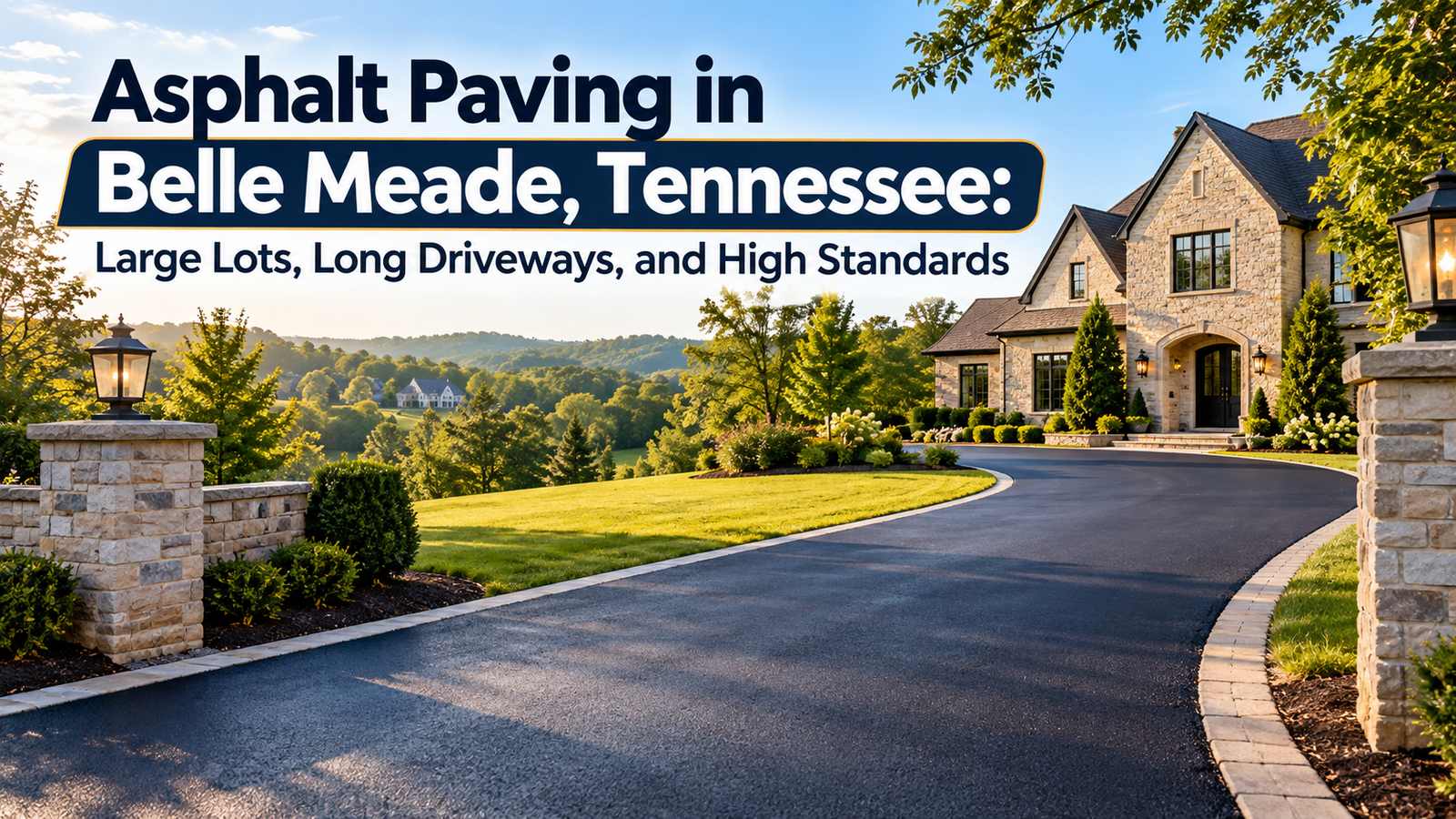

Belle Meade is a separate municipality entirely encircled by Nashville, occupying a relatively small but distinctive footprint in the western portion of the Nashville metro. The City of Belle Meade has consistently maintained one of the highest median household incomes in Tennessee, and its physical character reflects that economic position: large residential lots of one to five acres or more, extensive tree canopy, curvilinear street layouts following the topography of the western Nashville hills, and private driveways that can extend 100 to 500 feet or longer from the street to the residence.
The pavement demands of Asphalt Contractor Belle Meade are specific to this setting. Long, curved driveways traversing rolling terrain, circular drives and motor courts at large residences, driveways serving detached garages and carriage houses, and parking areas for gatherings and events all require pavement design that accounts for the specific soil conditions, drainage patterns, and loading expectations of each property. The aesthetic expectations in Belle Meade are also high pavement that looks tired, discolored, or poorly maintained is inconsistent with the character of a neighborhood defined by meticulous property maintenance.
Topography and Drainage in Belle Meade’s Rolling Terrain
Belle Meade occupies the western hills of Nashville, where the landscape rises and rolls away from the Cumberland River floodplain. Lot grades in the neighborhood range from gently sloping to moderately steep, with some properties featuring significant grade changes from the street to the building footprint. Driveway design on these sites is a drainage engineering exercise as much as a pavement selection decision.
Water management on sloped driveways in Belle Meade requires cross-slopes, surface swales, and in many cases trench drains or area drains at strategic locations. A properly designed driveway directs surface runoff to the sides rather than allowing it to sheet down the centerline sheet flow down a long slope can reach erosive velocities and undermine the driveway edge and surrounding landscape. At the base of long downward-sloping driveways, a trench drain or channel drain at the garage approach intercepts accumulated runoff before it enters the structure.
On curved driveways following the site topography, the superelevation the cross-slope that maintains drainage in curved sections must be designed into the installation. Improperly graded curves pond water in the low points of the curve, which are exactly the locations where freeze-thaw infiltration and pavement deterioration initiate.
Soil Conditions and the Importance of Subgrade Preparation
The soils of the Belle Meade area reflect the Nashville Basin geology: residual limestone soils with significant clay fractions, reddish-brown in color, and subject to shrink-swell behavior with seasonal moisture changes. Large lot properties in Belle Meade also frequently have areas of disturbed soil from previous landscaping, pool installations, utility work, and building additions where fill of varying quality was placed.
Subgrade preparation for long driveways in Belle Meade must address these soil conditions methodically. Organic topsoil is stripped for the full driveway width and depth of disturbance. Areas of previously placed fill are probed or proof-rolled to assess bearing capacity. Soft spots are excavated and replaced with compacted aggregate. Only after the subgrade is uniform and stable is the aggregate base placed and compacted.
For driveways with significant shade from the extensive tree canopy in Belle Meade, moisture retention in the subgrade is a particular concern. Shaded soil stays wetter longer after rain events, keeping clay subgrades in a higher moisture state that reduces bearing capacity. Adequate base thickness compensates for this by distributing loads over a larger subgrade area. Geotextile fabric between subgrade and base prevents fine-grain soil migration into the aggregate, which would degrade drainage and load distribution capacity over time.
Long Driveway Design: Structural Sections and Pavement Widths
Long private driveways in Belle Meade those over 100 feet in length warrant careful structural design because the cost of premature failure on a 300-foot curved driveway serving a major residence is substantial. The structural section specified for these driveways reflects both the expected vehicle loading and the site-specific subgrade conditions.
A standard long residential driveway in Belle Meade typically specifies five to six inches of compacted Class A aggregate base over prepared subgrade, topped with an asphalt section of two and a half to three inches total depth in two lifts a binder course and a surface course. For driveways that regularly receive catering trucks, moving vans, delivery vehicles, or event parking from oversized vehicles, a heavier structural section may be warranted.
Driveway width in Belle Meade ranges from ten to twelve feet for single-lane driveways on older properties to sixteen to twenty feet for two-lane or estate driveways. Motor courts at residence arrivals are designed for vehicle turning radii and for multiple simultaneous vehicles, with pavement sections and drainage systems appropriate for the anticipated use.
Aesthetic Considerations: Surface Appearance and Edge Details
Belle Meade’s properties are maintained to high aesthetic standards. Asphalt pavement in this context must not only perform structurally but also look well-maintained and properly detailed at its edges and transitions. The visual presentation of a long driveway contributes significantly to a property’s first impression.
Edge restraint and edge finish are critical aesthetic and structural elements. Asphalt edges without support where the pavement simply terminates at a graded shoulder ravel and crack quickly in Tennessee’s climate. Concrete edging, decorative pavers at the border, or properly compacted aggregate shoulders provide the lateral support that prevents edge deterioration. In Belle Meade, the edge treatment is often integrated into the landscape design, with the driveway edge transitioning to manicured lawn, ornamental stone borders, or formal landscape beds.
Driveway color changes over time as asphalt oxidizes in Tennessee’s UV intensity. Fresh asphalt is deep black. Oxidized asphalt turns gray. Sealcoating restores the dark appearance while providing the UV protection that slows further oxidation. In Belle Meade, where property appearance is a priority, sealcoating is often valued for its aesthetic effect as much as for its structural protection benefit the two are aligned.
Tree Root Management on Large Belle Meade Properties
Belle Meade’s extensive tree canopy is one of its most valued characteristics. The mature oaks, elms, maples, and ornamental trees on large residential properties define the character of the neighborhood. But these same trees produce root systems that extend well beyond the drip line and can disrupt driveway pavement over time.
Root management in driveway paving involves assessing the proximity of existing trees to the driveway corridor, identifying root concentrations through soil probing or visual inspection of existing surface disruption, and selecting an approach that balances pavement longevity with tree health. Root pruning at the excavation boundary, combined with physical root barriers installed to the appropriate depth, redirects future root growth away from the pavement structure without removing the tree. Selecting replacement species with less aggressive root systems when old trees are removed reduces the recurrence of this problem in future driveway cycles.
Sealcoating and Long-Term Maintenance for Belle Meade Driveways
The maintenance cycle for asphalt driveways in Belle Meade follows the same climate-driven logic as throughout the Nashville area. Sealcoating every two to three years, preceded by crack filling, is the standard professional recommendation. On large Belle Meade driveways, the sealcoating operation itself requires coordination the driveway must be clear of vehicles for the application period and for at least 24 hours of curing time, which may require planning around the property owner’s schedule and use patterns.
Crack sealing is performed with hot-pour rubberized sealant applied to clean, dry cracks. This flexible material accommodates the thermal movement that opens and closes crack widths seasonally, maintaining the seal through multiple freeze-thaw cycles without re-cracking at the treatment location. Addressing cracks promptly prevents the progression from surface crack to base infiltration to structural failure the sequence that determines whether a future project is a maintenance treatment or a full replacement.
Frequently Asked Questions: Asphalt Paving in Belle Meade
What makes long driveway design in Belle Meade different from standard residential driveways?
Length, grade, and aesthetic expectations all elevate the design requirements. Drainage engineering, proper subgrade preparation across the full length, heavier structural sections for estate driveways, and edge treatments that integrate with the landscape design are all part of the professional approach.
How is drainage managed on curved downhill driveways?
Cross-slopes in straight sections and superelevation in curved sections direct water off the surface. Trench drains at grade transitions and at the base of long slopes intercept concentrated runoff before it reaches the garage or building entrance.
What does tree root management involve in driveway paving?
Root pruning at the excavation boundary, installation of physical root barriers, and species-appropriate replanting decisions. The goal is to preserve trees while redirecting root growth away from the pavement subbase.
Why does sealcoating matter for appearance as well as performance in Belle Meade?
Sealcoating restores the dark appearance of oxidized asphalt while blocking UV degradation and moisture infiltration. In a neighborhood where property appearance is a priority, the aesthetic benefit is aligned with the structural protection function.
What structural section is typical for a Belle Meade estate driveway?
Five to six inches of compacted Class A aggregate base over prepared subgrade, topped with two and a half to three inches of asphalt in two lifts. Driveways serving heavy vehicles use heavier sections.
Belle Meade’s large lots, long driveways, rolling terrain, and high aesthetic standards create a pavement environment where preparation and quality of execution matter more than in typical residential settings. Professional asphalt work in this context combines engineering discipline with the attention to detail that the neighborhood’s character demands a combination that produces driveways that perform for decades in Tennessee’s demanding climate while meeting the expectations of one of Nashville’s most distinguished communities.